
No-parking zone during relocation: How to secure your parking space Here you can find out when a no-parking zone is worthwhile, how much it costs, what deadlines apply—and how DACHSER & KOLB can handle the matter for you.
If the moving truck cannot find a place to park, you pay twice: time (downtime, transport distances) and risk (damage due to hectic conditions, longer carrying distances, unclear traffic routing). A correctly set up no-parking zone reduces precisely these friction losses – measurably.
Typical consequences without a no-parking zone:
- Longer carrying distance: More meters per box = more time = more strain on furniture, walls, stairwells.
- More staff/travel time: “Short loading” becomes “shuttling” (shuttle service) – which drives up the price.
- Higher risk of damage: Narrow paths, curbs, risky stops – bad for quality and nerves.

What is a no-parking zone when moving house?
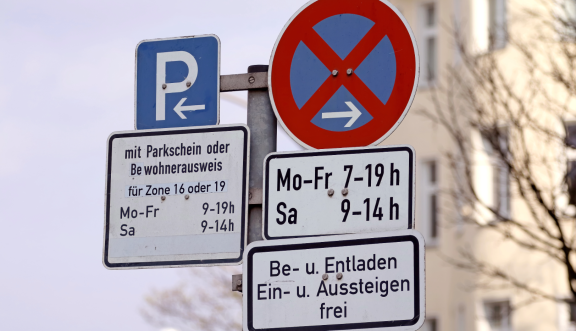
A no-parking zone is a temporarily reserved area of a road where vehicles are not allowed to stop or park, so that your removal vehicle can be parked directly at the loading address. It is marked with traffic signs and additional signs.
Important: Temporary no-parking zones must be ordered/approved by the authorities.
What are the benefits of a no-stopping zone?
✓ Predictable arrival instead of a parking lottery
✓ Shorter distances (carrying distance) = less time = lower costs
✓ Greater safety when carrying, less narrow paths
✓ Less risk of damage to furniture/property
✓ Better quality of execution (calmer, more structured process)
✓ More control over the moving day (fewer uncertainties)
The 6 advantages of a no-parking zone when you move house

Price certainty:
Less downtime, fewer surprises in the process.

Quality:
Quiet, clean loading instead of chaos and temporary parking

Safety:
Less risk of damage to furniture, stairwells, and curbs.

Speed:
Short carrying distance, clear timing, faster loading.

Comfort:
You don't have to deal with authorities, signs, and deadlines.

Control:
Plannable moving day – even with a tight time frame.
When is a no-parking zone particularly useful?
It almost always makes sense if at least one of the following points applies:
✓ City center/narrow residential street, high parking pressure
✓ You are moving out of/into multiple floors without sufficient loading space
✓ Heavy or bulky goods (e.g., piano, large cabinets)
✓ Time window is tight (handover, keys, elevator slots)
✓ Additional technology planned: external lift/plug-in lift (requires space + safe installation area)
Step by step: How to get to the no-parking zone safely
Clarify requirements
How many meters of loading zone do you realistically need? (Rule of thumb: it's better to measure correctly rather than scarcely.)
Specify address & set time slot
Consider the loading and unloading addresses separately.
Obtain official permits/approval
Road traffic authority/district office, depending on the city.
Put up signage on time
Including additional symbols and arrow direction. Also pay attention to visibility.
Documentation & Moving Day Management
Keep the area clear, time the process, and keep loading routes short.
What we need from you to ensure everything runs quickly and correctly
To ensure that DACHSER & KOLB can access the no-parking zone without any queries, please provide:
- Exact address(es) for loading and unloading zone
- Moving date + preferred time slot
- Special features on site: construction site, one-way street, driving bans/access restrictions, elevator situation
- General information about the move: number of floors, approximate volume (e.g., cubic meters/household size)
- Optional, if you are packing yourself: status “Packed by Owner” (PBO) and whether delivery of packing materials is desired

Practical checklist: No-parking zones without stress
✓ approximately 14 days in advance
Clarify requirements, submit application/disposition.
✓ 3-4 days in advance
Have no-parking signs prepared (note the deadline).
✓ Moving day
Check the area, keep the loading route clear, and keep the removal route short.
✓ After moving
Have no-parking signs removed on time.
✓ All done?
→ Unnecessary stress avoided.

Costs: What you should expect
The costs vary from place to place and typically consist of:
- Official fees (example: the city of Bochum charges based on duration).
- Signs/materials (rental) and, if applicable, installation service.
- Cost drivers: length of the zone, duration, traffic situation, additional requirements.
Note: A no-parking zone costs money – not having a no-parking zone often costs more (downtime, shuttle service, detours).
What DACHSER & KOLB does for you
To ensure that your move goes smoothly without any downtime or improvisation, DACHSER & KOLB takes care of the entire process:
- Clarification of the appropriate loading zone length (based on vehicle type, volume, conditions)
- Submitting the permit/order to the relevant authority
- Setting up no-parking signs in a timely manner and in accordance with regulations
- Coordinating logistics: carrying distance, floors, bottlenecks, time slots
- Optional: Planning for external lifts/plug-in lifts and the necessary space
- Quality components in the move: Load securing, protective material (e.g., edge protection), transport insurance

Frequently asked questions about no-parking zones when moving house
How far in advance do I need to apply for a no-parking zone?
Depending on the city, it is best to plan around 14 days in advance. It may work at short notice, but it is risky.
When must the signs be in place at the latest?
Often, the rule is: at least 3–4 days in advance. Some cities explicitly state “no later than the 4th day in advance.”
How much does a no-parking zone cost?
Fees and additional costs (signs/service) vary depending on the municipality. For example, cities charge fees based on duration; in addition, there are sign rental and, if applicable, installation service fees.
What happens if someone parks there anyway?
In the case of an officially designated zone and correctly observed deadlines, measures up to and including towing are generally possible; details are local and case-dependent.
How long must the no-parking zone be?
It depends on the type of vehicle and the maneuvering space. If you plan too tightly, it leads to downtime or reparking—that's the classic scenario.
Can DACHSER & KOLB take over the entire no-parking zone?
Yes—from scheduling and the approval process to signage.
Contact us for a free consultation!
By setting up a no-parking zone in good time, DACHSER & KOLB ensures that your move goes smoothly, without detours, delays, or stress. Contact us for a no-obligation consultation!
We are here for you
We couldn't answer your questions?
Then don't hesitate to contact us.
Donna Draganov
Teamlead Customer Service & Sales - ROAD

Why DACHSER & KOLB is the right choice

Personalized advice
Detailed needs analysis for customized relocation solutions.

Relocation planning from A to Z
Complete relocation planning: from packing to unloading, all from a single source.

Reliable network
Global network for safe, seamless transport.